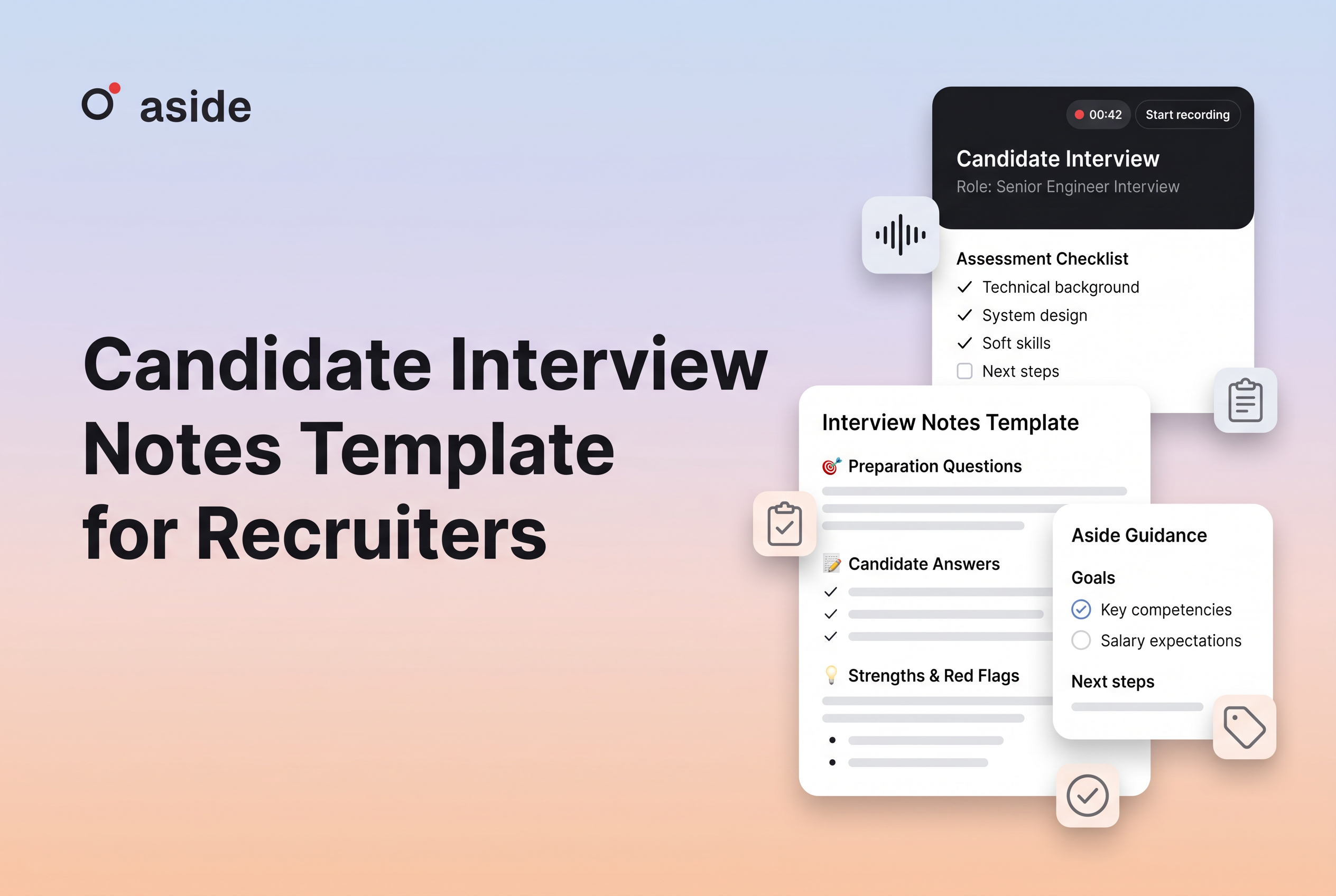
The best candidate interview notes template for a recruiter's screen has two halves: what the candidate said, kept apart from what you think of it, plus a short submission you can send the client straight after. Copy the one below, fill it in within five minutes of hanging up, and your notes will survive a client query, a candidate asking for their data, and your own memory a fortnight later.
Most recruiters write notes the way they talk: "good energy, bit salesy, probably fine on money." That works until someone else has to rely on it. This post gives you the structure, a worked example for a 20-minute sales screen, the client write-up that follows, and the rules of thumb people keep asking about, from red flags to the 30-60-90 rule.
Why candidate interview notes need a fixed structure
A fixed structure makes your notes comparable, defensible and fast to write. Free-form notes fail on all three.
Comparable: if you screen six people for one role, you need the same fields for each, or you end up comparing your moods, not their evidence. Defensible: in the UK and Ireland, interview notes, scores and recorded opinions about a candidate can be their personal data, so a candidate can ask for them through a subject access request (ICO guidance, 2026). Anything you write should be something you could justify if the candidate read it. Fast: a template means you stop deciding what to write and start filling boxes.
The practical rule that follows is simple. Keep what happened and what you think in separate fields, and label opinion as opinion.
The candidate interview notes template (copy and paste)
Paste this into your ATS, a doc or an email draft. Every field has one job.
Candidate: Name | Role screened for | Client | Date | Call length
1. Basics (facts only) Current employer and title | Notice period | Location and working pattern | Salary expectation and current package (as stated by the candidate) | Right to work confirmed (Y/N)
2. Motivation (their words) Why looking | What would make them move | What they want to avoid
3. Evidence against the role criteria For each of the 3 to 5 criteria in the brief: Criterion | What the candidate said or described (context, their part, what they did, the result) | Gaps or follow-up needed
4. Other processes and timing Other interviews live | Offers pending | Availability for interview
5. Recruiter assessment (opinion, labelled) Rating per criterion against your scale, with one line of evidence for each | Overall view | Concerns | Recommendation (submit / hold / reject)
6. Next steps What you promised the candidate | What the candidate promised you | Deadline for each
The split between section 3 and section 5 is the whole point. Section 3 is evidence. Section 5 is your judgement of it.
A filled-in example: a 20-minute screen for a sales hire
Here is the template filled in for a hypothetical screen: a mid-market SaaS account executive role, Manchester or hybrid.
Candidate: Sam R. | AE, mid-market SaaS | Client: Northgate Software | 12 March | 20 min
1. Basics: Currently AE at a payments scale-up | 3 months' notice | Manchester, wants 3 days in office | Expects £65k base plus OTE of £130k, currently £58k base | Right to work confirmed.
2. Motivation: Said the current team has been cut from 8 reps to 5 and territory has doubled. Wants a defined patch and a manager who coaches. Does not want pure outbound.
3. Evidence:
Closing £50k+ deals: Described a £72k deal closed in Q4 with a 4-month cycle, three stakeholders, and a procurement round he handled himself. Did not mention discounting.
Outbound pipeline generation: Said around 30% of his pipeline is self-sourced. Could not give a number for meetings booked per week. Follow-up needed.
Managing a long cycle: Gave one clear example, the same Q4 deal, with a mutual close plan.
4. Other processes: Final round elsewhere next Thursday. No offers yet. Free for interviews any afternoon next week.
5. Recruiter assessment (opinion): Closing: strong, supported by the £72k example. Outbound: moderate, one number given, no activity metrics. Overall: submit. Concern: notice period against the client's start date. Recommendation: submit.
6. Next steps: I send the client submission today. Sam sends his last two quarters of quota attainment by Friday.
Notice what is absent: no "charming", no "seemed evasive", nothing about age, family or accent. If a note cannot be tied to the role, leave it out.
How to write good interview notes: evidence first, opinion second
Write what the candidate said or did first, then your assessment of it, in that order and in separate fields.
A useful test: "Compared two options using delivery data and proposed a revised timeline" is evidence. "Strong problem-solver" is an assessment, and it only counts when you tie it to a criterion and a piece of evidence. Vague labels like "not a fit", "polished" or "aggressive" are the ones to replace with specific, job-relevant behaviours, or delete if you cannot back them up.
Three habits make this work:
Capture context, their part, actions and result for each example. If the result is missing, note the gap rather than filling it in with a guess.
Score against the same scale for every candidate, with at least one line of evidence behind each score.
Add the candidate's disagreement if they push back on a point. A candidate disagreeing with your opinion does not make the note inaccurate, but recording their view is good practice (ICO guidance, 2026).
On retention: keep notes only as long as your retention policy says, and store them securely. If a subject access request arrives, you will need to find them, so keep them in one place and not scattered across a notebook, a text thread and your inbox.
What to send the client after the screen
Send a short submission, not your raw notes. The client needs the headline, the evidence for the criteria they care about, and the logistics, in under 150 words.
Use this shape:
Subject: Sam R., AE, for Northgate: submitted
Hi [Name],
Sam is a mid-market AE currently at a payments scale-up, with a £72k deal closed in Q4 after a four-month, three-stakeholder cycle.
Closing: Strong. Ran procurement himself and used a mutual close plan.
Outbound: Moderate. Roughly 30% self-sourced pipeline; I am asking for his activity numbers.
Logistics: 3 months' notice, Manchester, 3 days in office, expects £65k base. Final round elsewhere next Thursday, so timing matters.
My view: worth meeting. His notice period is the main risk against your start date. Free any afternoon next week.
Best, [You]
Keep the opinion labelled ("my view") and the facts above it. That is the same split as your internal notes, which is why the write-up takes two minutes. If the client later pushes back on a candidate, Client Rejects Your Candidate: What Recruiters Say covers the call. If the candidate wobbles after you submit, see Candidate Pulls Out of the Process: What Recruiters Say.
Red flags, the 30-60-90 rule and other interview rules of thumb: what to note and what to skip
Note behaviours you can describe; skip impressions you cannot defend.
What is a red flag? In your notes, a red flag is a specific, job-relevant behaviour: a vague answer on an achievement they claim, shifting dates, no reason for leaving, or a salary figure that moves mid-call. Write "could not name the result of the project" and not "evasive". The first is evidence. The second is a label.
The 30-60-90 rule. This is a plan structure: what a hire will do in their first 30, 60 and 90 days. It belongs in the client's brief and in the candidate's answer to "how would you approach the first three months?" Note what they said, and whether it matches what the client described.
The 80/20 rule. The candidate should talk roughly 80% of the time on a screen. If you noted a lot of your own talking, you probably have thin evidence.
The 10-second rule. Some people use the first ten seconds to form an impression. Do not write that down. It is the least defensible note you can make. Wait for evidence.
Thank-you notes. A candidate's thank-you after an interview is a courtesy, not evidence. If it contains something relevant, such as a correction or a new fact, log that fact. Skip the tone.
What to skip entirely: personal characteristics unrelated to the role, speculation about motives, and anything you would not want read back to the candidate. For salary, notice and counter-offer conversations, see Salary Expectations Conversation: What Recruiters Say and Candidate Got a Counteroffer: What Recruiters Say on the Call.
Let Aside record the call and write the notes for you
Aside is a Mac and Windows app that records your calls on your computer and writes up notes, goals reached and next steps afterwards, with no bot joining the call.
For a recruiter, that changes the order of work. You run the screen, listening instead of typing, then open the write-up and drop the evidence into the template fields. It records Zoom, Google Meet, Microsoft Teams, Slack huddles and FaceTime, plus phone calls through your computer, so the same workflow covers a video interview and a quick phone screen. It transcribes English plus 24 European languages, which helps if you recruit across the UK, Ireland and the EU.
Because no bot joins, the candidate does not see an extra "notetaker" in the participant list. Tell candidates you are recording, as you would with any recording, and keep the retention rules above in mind for the notes you keep.
Aside is free forever for unlimited recording, notes and transcripts. New accounts get 14 days of Pro with no card, which adds write-ups, summaries and a follow-up email on every call. Pro is $48 a month, or $456 a year.
Use the template on your next screen, and let Aside fill the first draft
A good candidate screen produces two things within minutes: notes that keep evidence apart from opinion, and a short client submission built from them. Copy the template, use the same fields every time, and stop writing conclusions you cannot back up. Then take the typing out of it: install Aside, record your next candidate screen, and edit the write-up into the template instead of starting from a blank page.
Questions
How do you write good interview notes?
Record what the candidate said or did first, then your assessment in a separate field, tied to a role criterion with at least one line of evidence. Use the same scorecard for every candidate and replace vague labels with specific behaviours. Aside records the call on your computer and drafts notes and next steps, so you edit instead of typing.
Can a candidate ask to see my interview notes?
Yes. Interview notes, scores and recorded opinions can be a candidate's personal data, so they can request them through a subject access request (ICO guidance, 2026). Write only what you could justify if they read it, keep notes accurate and professional, and store them in one secure place.
What is the 30-60-90 rule in an interview?
It is a plan for a new hire's first 30, 60 and 90 days. In a screen, note how the candidate describes their first three months and whether it matches the client's brief. Log what they said as evidence, then give your view of the fit separately.
What is a red flag in an interview?
A job-relevant behaviour you can describe, such as no clear result on a claimed achievement, shifting dates, or a salary figure that changes mid-call. Note the specific behaviour, not a label like "evasive". With Aside's transcript to hand, you can quote what the candidate actually said.
Should I send the client my raw notes after a screen?
No. Send a short submission of under 150 words: the headline, evidence on the client's key criteria, logistics, and your labelled view. Keep the raw notes internal. Aside's post-call write-up gives you the evidence and next steps to build that email quickly.