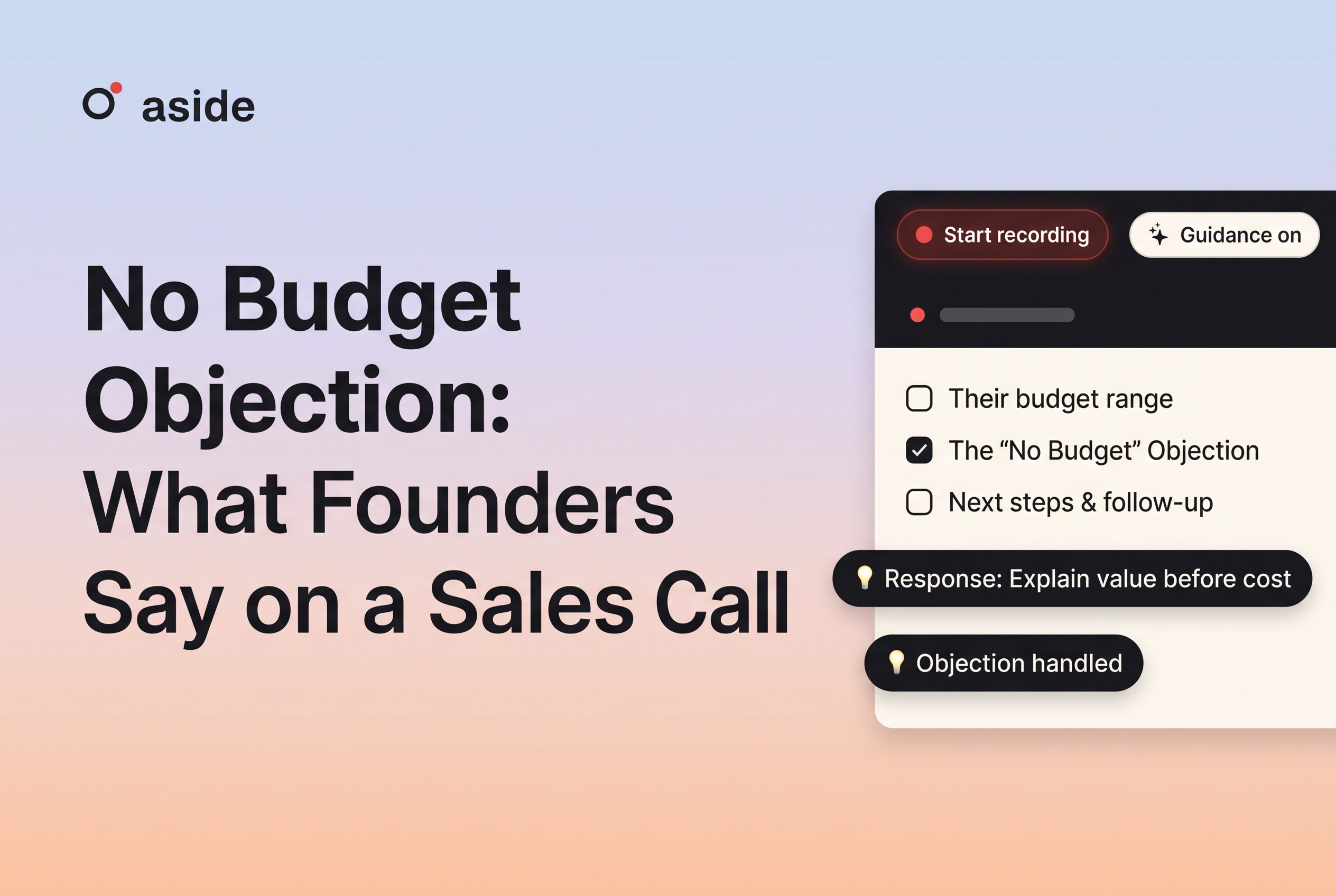
A no budget objection is a clue to diagnose, not a cue to discount: "we don't have the budget" can mean the money is locked, the problem isn't a priority, or your contact can't sign, and one neutral question tells you which. Founders who still run their own discovery calls tend to hear it, panic, and either offer a discount or fold the call. Both moves lose. This guide gives you the diagnosis, the exact words for each case, and clear rules for when to offer a smaller step and when to walk away.
What "We Have No Budget" Usually Means
"We have no budget" is rarely a literal statement about a bank balance. It's a polite way to end a conversation, and it hides one of three things: the money genuinely isn't available, the problem isn't a priority, or your contact can't authorize the spend.
That's how the no-budget method works. You don't argue with the sentence. You treat it as a symptom and run one question to find the cause. Each cause has a different fix, and the wrong fix wastes the call.
The three objection categories most sales guidance uses map onto this: budget, priority (the need or urgency) and authority. A fourth, timing, shows up as a flavor of budget. Sort the objection in the first 20 seconds and you stop reacting to the words and start responding to the situation.
A locked budget and a low priority sound identical on the phone. They aren't. One is a calendar problem, the other is a value problem, and waiting for next quarter won't fix a value problem.
No Budget vs No Priority vs No Authority: One Question to Tell Them Apart
One neutral question separates the three causes: "Is there no budget for this kind of purchase right now, or would this need to become a higher priority to get funded?"
Say it slowly and without any edge. You aren't challenging them. You're offering two honest options and letting them pick.
Listen for what comes back:
"Budgets are locked until January." That's real no budget. The constraint is timing.
"Honestly, it's not something we're focused on." That's no priority. The money exists, it just isn't pointed here.
"I'd need to run it by my boss / finance." That's no authority. Your contact likes it but can't approve it.
A vague non-answer. Ask a second, softer question: "What would have to be true for this to get funded?"
Founders skip this part. They hear "no budget" and jump straight to price, which is the one thing that doesn't matter yet. If you want the full price-side playbook once you've confirmed money is the real issue, see Price Objection on a Sales Call: What to Say.
Exact Phrases to Use When the Budget Really Is Locked
When the budget really is locked, your job is to keep the door open without pushing. Ask about the calendar and let them tell you the next move.
Use these phrases:
"That makes sense. When do budgets reset for you?"
"Would it be useful if I followed up a few weeks before planning starts?"
"If it helps, I can send a short summary you could use when you put the request together. Want that?"
Note the last one. Offer to help build a business case only if the buyer wants it. Pushing a business case on someone who just told you the money isn't there reads as pressure.
Then agree on a specific date. "I'll check back on the 3rd" beats "let's stay in touch" every time, because it gives you a reason to reach out and gives them a commitment small enough to say yes to.
Write the date and the reason down straight after the call. A locked budget you forget about is just a lost deal with extra steps.
What to Say When It's Really No Priority
When it's really no priority, stop talking about money and start talking about the problem. Ask what matters most right now and what the current situation is costing them.
Try these:
"What's taking up most of your attention this quarter?"
"What's the current problem costing you, in time or in missed deals?"
"If this stayed exactly as it is for another six months, what happens?"
These questions aren't a trick to manufacture urgency. They're a test. If the buyer can describe a real cost, you now have something to anchor the conversation on, and the budget objection often softens by itself because the priority just moved.
If they can't name any meaningful impact, believe them. Don't invent urgency. Pushing a prospect to feel pain they don't feel produces a pause, then a ghost, then a wasted follow-up sequence. The honest outcome of this branch is sometimes "this isn't a problem for you right now," and learning that in ten minutes beats learning it in ten weeks.
If the buyer's real concern turns out to be that your price feels high against the value, that's a different objection and the price objection guide covers it.
When to Offer a Smaller Step, and When Not to Discount
Offer a smaller step when the buyer is interested but cautious. Never lead with a discount, because a discount answers a question they didn't ask.
A smaller step is a measurable, bounded way to start: a limited pilot, a single use case, a short trial with a clear success measure. It fits when the constraint is risk or cash flow and the interest is real. A phrase that works: "Would it make sense to start with one small piece and see if it moves the number you care about?"
A discount does the opposite. It teaches the buyer that your price was negotiable all along, and it doesn't touch the actual blocker. If the real problem is no priority or no authority, a lower price solves nothing.
The rule is simple. Offer a smaller step only if it genuinely fits their constraint and you can still deliver it properly. If shrinking the scope means you can't do good work, say so. Cutting a price on a deal that never had a priority is just a slower no.
When to Walk Away From a No-Budget Prospect
Walk away, or pause the opportunity, when there's no real need, no plausible funding path in the foreseeable future, a better-fit option exists for them, or they clearly ask you to stop.
That last one is non-negotiable. A clear "please stop" ends the sequence immediately.
For the other cases, use a clean exit line: "It sounds like the timing isn't right and there's no clear path to funding this soon. Do you want me to check back on a specific date, or should I close this out for now?"
That question respects them and protects your time. Founders who still sell their own product have the least spare time of anyone, so a prospect who keeps saying "maybe next quarter" with no date, no named owner and no stated pain is costing you real hours.
If they want a revisit date, set it and move on. If they don't, close it out politely. A tidy no is worth more than a zombie lead sitting in your pipeline, because it frees you to spend the next call on someone who can actually buy.
Staying Calm When the Objection Lands Live (and Where Aside Fits)
The hard part isn't knowing the phrases. It's remembering them when someone says "we have no budget" and your mind goes blank.
That's where Aside fits. Aside is a Mac and Windows app that records calls on your computer and can provide live guidance, helping you know what to say next while the buyer is still talking. No bot joins the call, and afterward it writes up notes, goals reached and next steps.
It works on Zoom, Google Meet, Teams, Slack huddles and FaceTime. Free forever covers unlimited recording, notes and transcripts, with live guidance and a write-up on 2 calls a week. Pro is $48/month, or $456/year, for live guidance and write-ups on every call.
Prepare your three answers before the call: one for locked budget, one for no priority, one for no authority. Then you're reading from a plan instead of improvising.
FAQ: Handling Objections in Sales
These are the questions founders ask most about handling objections on a live call.
What are the major 3 objection categories?
The three that matter most for a no budget objection are budget (the money or timing isn't available), priority (the problem isn't urgent enough to fund), and authority (your contact can't approve the spend). Sorting the objection into one of these in the first minute tells you which response to use.
What are the top 5 objections founders handle?
The five that come up most are no budget, price is too high, we already use something else, send me an email, and I need to check with someone. Each one is a clue, not a verdict. The diagnostic question works across all of them: find the real cause before you answer.
How do you overcome objections in sales?
Acknowledge the objection, ask one neutral question to find the real cause, then respond to that cause rather than the surface words. Don't argue, don't rush to discount, and know when to leave. A calm, curious tone does more than any rebuttal script.
Diagnose first, then decide: your next no-budget call
A no budget objection is information, and the founders who win get curious instead of defensive. Ask the one neutral question, sort the answer into budget, priority or authority, use the matching phrase, and walk away cleanly when there's no path to yes. Before your next discovery call, write your three answers down. Then try Aside free, with 14 days of Pro and no card, so the right question is on your screen the moment the objection lands.
Questions
How does the no-budget method work?
You treat "we have no budget" as a clue and ask one neutral question: is there no budget for this kind of purchase right now, or would it need to become a higher priority to get funded? Their answer sorts it into locked budget, no priority or no authority, and each gets a different response. Aside can keep that question on screen live.
What are the major 3 objection categories?
For a no budget objection, the three categories are budget (timing or funds), priority (the problem isn't urgent enough), and authority (your contact can't approve it). Identifying which one you face tells you whether to ask about budget cycles, probe the cost of the problem, or ask who else needs to weigh in.
Should I offer a discount when a prospect says they have no budget?
No, not as your first move. A discount answers a question they didn't ask and doesn't fix a priority or authority problem. Offer a smaller, measurable first step only if the buyer is interested but cautious and it fits their constraint. Otherwise, diagnose first and keep your price intact.
When should I walk away from a no-budget prospect?
Walk away when there is no real need, no plausible funding path soon, a better-fit option for them, or a clear request to stop. If they want a revisit date, agree a specific one; otherwise close it out politely. Aside's call notes and next steps help you record the date you agreed.