A recruitment business development call script needs five stages: a 20-second opener, a clear reason for calling, qualifying questions on the vacancy, a calm answer to "we use other agencies" and "we have no budget", and a firm next step on terms. Below is exact wording for each stage, plus what to say when the hiring manager takes the call somewhere you didn't plan.
A script is not something you read out. It's a map. The recruiters who win vacancies sound like they're having a conversation, but they always know which stage they're in and what the next move is. Use the wording below as a starting point, then bend it to your desk, your sector and your voice.
What a recruitment business development call needs to achieve
A business development call has one job: to get a specific vacancy, or a specific next step towards one, from a hiring manager who didn't ask to hear from you. Everything else is a distraction.
That means you are not trying to sell your agency on the first call. You want three things: to find out whether there is a live need, to understand enough about it to sound credible, and to agree a small, dated next step. That next step is usually a proper intake call, or sending your terms of business so you can work the role.
Set yourself a goal before you dial. "Get the vacancy" is too vague. Try "agree a 15-minute brief on Thursday" or "confirm who signs off terms." A call with a clear goal is easy to steer. A call with no goal drifts into a pleasant chat that goes nowhere.
Keep the call short. Hiring managers are busy and they have never heard of you. Two minutes of relevant questions beats ten minutes of agency history.
Stage 1: The opener (first 20 seconds)
The opener must say who you are, what you recruit and why you're calling, in about 20 seconds, then ask permission to continue. Skip the "how are you today?" filler. It signals a cold call before you've said anything useful.
Try this:
"Hi [Name], it's [Your Name] from [Agency]. I recruit [specialism] roles in [region]. I noticed you're hiring for a [role]. Have you got two minutes?"
Three things make this work. It names a real role, so it's clearly not a blast. It names your niche, so they can place you quickly. And it asks for two minutes, a small, honest ask that's easy to say yes to.
If you don't know of a live role, swap the middle line: "I work with [type of company] on [type of hire]. Is that something you're looking at this quarter?"
When they say "what's this about?" or "I'm busy," don't push. Say: "Fair enough. Would it be easier if I called back at a better time today or tomorrow?" Booking a callback is a small win, and it beats being hung up on.
Stage 2: The reason for your call
The reason for your call should be one sentence about them, not a paragraph about you. Tie it to the role, the market or a specific problem they probably have.
Try:
"I'm calling because I've been speaking to a few [job title] candidates who aren't actively applying, and I wondered whether the [role] you're hiring for is still open."
Or, if the role has been advertised for a while:
"I saw the [role] has been live for a few weeks. What's been the hardest part to find so far?"
That second version does the heavy lifting. It invites them to complain, and a hiring manager who is complaining about their search is already half-sold on talking to you.
Avoid these:
Long lists of the clients you've worked with.
Claims about speed or quality you can't prove on the call.
"We'd love to partner with you." Nobody has ever said yes to that.
Keep any placement claims accurate and specific. If you've genuinely placed someone similar in the past, say so in one line. If you haven't, don't imply it. Hiring managers can smell a stretch.
Stage 3: Qualifying questions on the vacancy
Qualifying questions tell you whether the vacancy is real, urgent and winnable, and they make you sound like a recruiter who understands the job. Ask fewer questions than you think you need, and listen to the answers.
Work through these in roughly this order:
Is it live? "Is the [role] definitely open, or still being scoped?"
Why now? "What's driving the hire? Growth, or replacing someone?"
How's it going? "How's the search been so far? Any decent shortlists?"
What's blocking it? "What's been hardest to find?"
Who decides? "Who else is involved in signing this off?"
Timeline. "When would you ideally want someone in seat?"
Question five matters more than it looks. If the hiring manager can't agree terms, you need to know early. It tells you whether you're talking to the decision-maker or someone who'll pass your details to HR, where you may hit a preferred supplier list (PSL) and a very different conversation.
When they give you a vague answer, don't accept it. "When you say it's been tough, is that volume of applicants or quality?" gets you something you can actually work with.
For a fuller question bank for the follow-up brief, see Intake Meeting Questions to Ask a Hiring Manager.
Stage 4: Handling 'we use other agencies' and 'we have no budget'
Don't fight either objection. Acknowledge it, find out whether there's a real gap, and offer a small next step instead of a replacement pitch.
"We use other agencies."
This is the most common answer you'll get, and it is rarely a flat no. Say:
"That makes sense. Plenty of teams I speak to already have agency partners. I'm not suggesting you swap anyone out. Where do they do well, and are there any roles, locations or hard-to-fill searches where you still want more coverage?"
If they name a gap, follow up once: "How are you handling that role at the moment, and when would extra support be useful?" Then offer something small: "If you're open to it, I can share how we'd approach that search. Would a quick conversation be useful?"
If they say they're satisfied and have nothing live, respect it. Ask: "When's your next supplier review, or when does it make sense to reconnect?" A dated callback is worth more than a forced pitch.
The same applies if they mention a PSL. Don't argue with it. Ask: "How does a new agency usually get onto the list, and is there ever a route for specialist or one-off roles?" Sometimes the answer is no. Sometimes there is a back door for hard-to-fill roles. You only find out by asking.
"We have no budget."
This can mean three different things: no approved headcount, no appetite for fees, or a polite brush-off. Find out which:
"Understood. Is that no budget for the role at all, or no budget for agency fees? And if the role is going ahead anyway, how are you planning to fill it?"
If the role isn't approved, ask when it likely will be and note it. If it's the fees, don't discount on the call. Say: "I'd rather not guess. If I send over our terms and you can see the structure, we can talk about whether it works for this role." That buys you time to talk about fees properly. You are not defending a number from memory.
Don't promise a discount to keep the call alive. You'll regret it on the first invoice.
Stage 5: Agreeing the next step and terms
Close every call with a specific next step, in the diary, before you hang up. "I'll send some information" is how business development calls die.
When they're engaged:
"Sounds like a role I can help with. The best next step is a 15-minute brief so I understand exactly who you're after. Would Wednesday at 10 or Thursday at 2 suit?"
Then move to terms, lightly:
"I'll send our terms of business over today so you've got them before we speak. Who should those go to for sign-off?"
That last question does two jobs. It gets the right name, and it flags early if someone else needs to approve. If they hesitate, ask: "Is there anything in a standard set of terms that would stop you working with a new agency?" It's far better to hear a concern now than after you've started sourcing.
If they won't commit to a brief but are warm, ask for something even smaller: "Could I send over two or three profiles in the next few days so you can judge for yourself?" Only offer that if you can genuinely deliver it, and only with the candidate's agreement.
Repeat the agreed next step back to them in one line, with a day and a time. That's what you'll put in your confirmation email.
Keeping the script flexible on a live call
A script breaks the moment the hiring manager says something you didn't expect, so train yourself to hold the stages loosely and the goal tightly. If they jump straight to "what are your fees?" at the opener, don't panic. Answer honestly that fees depend on the role and you'll send terms, then bring the conversation back to the vacancy: "Before I do, what's the role and what's been tricky about it?"
A few off-script moments and how to handle them:
They start talking about the role unprompted. Stop pitching. Switch straight to Stage 3 and take notes.
They ask about candidates you don't have. Don't invent any. Say: "I'd want to take a proper brief first so I'm not sending you the wrong people."
They go quiet. Ask an open question and wait. Silence is not your enemy.
They ask for an email. Agree, but trade for something: "Happy to. So I send the right thing, what's the one role you most need filled?"
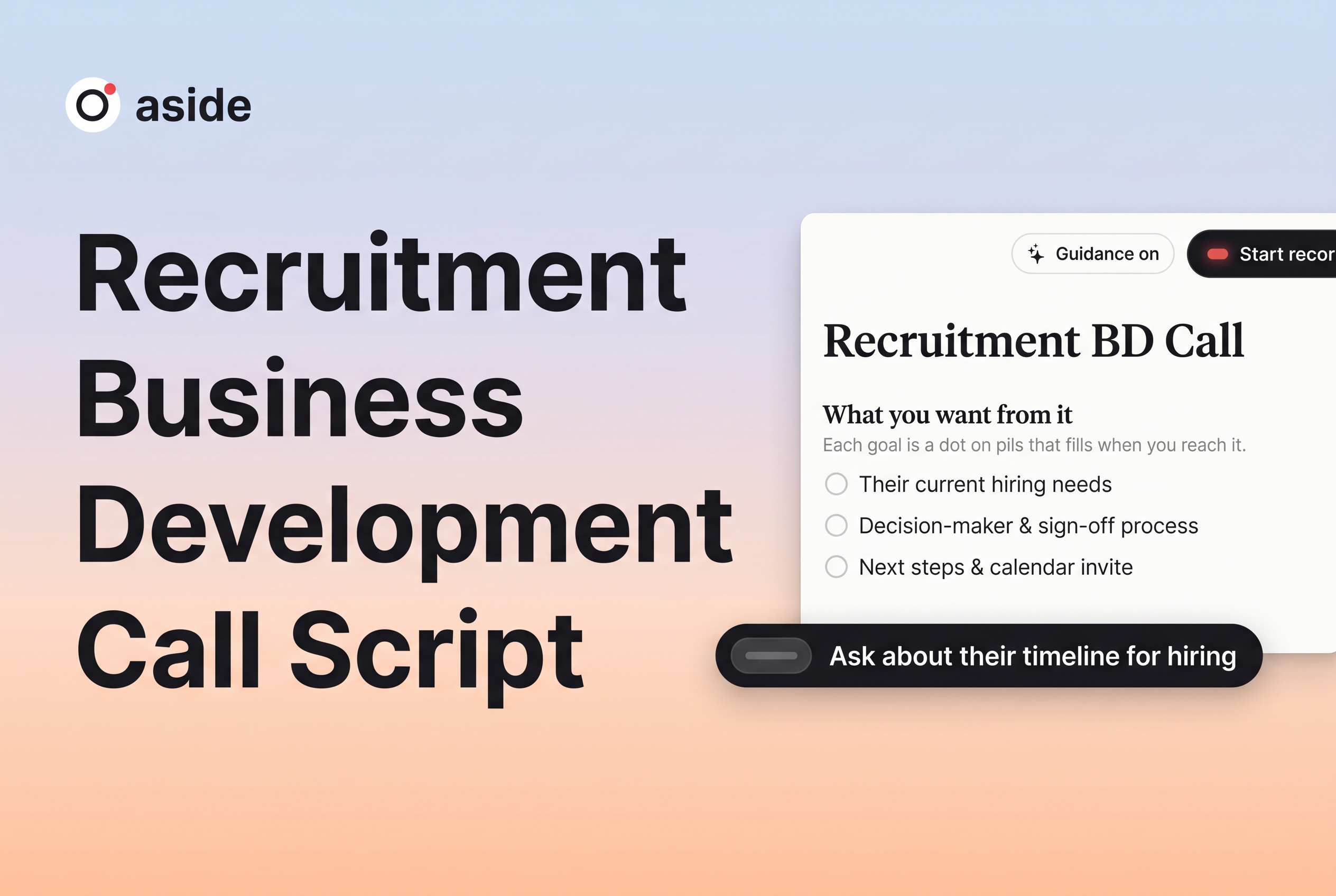
If you want help remembering your next move while you're mid-conversation, a live sales call assistant can sit alongside you. Aside is a Mac and Windows app that records the call on your computer and, with live guidance on, gives live guidance on screen. No bot joins the call, so the hiring manager sees nothing different. Audio is transcribed on-device in supported conditions, but may be sent to a speech-to-text provider if cloud transcription is enabled, the language is unsupported, or the computer cannot keep up.
For more on how a live assistant differs from a plain note-taker, see AI Notetaker vs Live Call Assistant: Which Helps on Calls.
After the call: notes and follow-up
The follow-up is part of the call, and it should go out within the hour while the conversation is fresh. Write down four things straight away: the role and its status, the reason for the hire, who signs off terms, and the agreed next step with its date.
Then send a short email:
"Hi [Name], thanks for your time today. As discussed, we'll speak on [day] at [time] to go through the [role] brief. I've attached our terms of business so you have them in advance. If anyone else should be on the call, let me know."
Keep it to a few lines. Don't re-pitch in writing.
If you recorded the call, Aside writes up notes, goals reached and next steps for you, so you aren't reconstructing details from memory between dials. The free plan includes unlimited recording, notes, transcripts, and search, but live guidance and write-ups are limited to two calls a week. Pro adds live guidance and write-ups on every call, including summaries and a follow-up email; research briefs are also a Pro feature. New accounts get 14 days of Pro with no card. Always tell the other person you're recording and check what's appropriate for your agency before you do.
If the call ended with "not now," log the date they gave you and diarise the callback. Most agency business comes from the second and third conversation, not the first. The recruiter who calls back when they said they would is already ahead of most of the market.
Once a vacancy is yours, the same discipline carries into candidate calls. See Recruiter Phone Screen Questions: What to Ask and When for the next stage.
Write your five stages down, then try them on your next dial
A recruitment business development call script works when each stage has one job and you know the wording cold. Write your opener, your reason for calling, your six qualifying questions and your two objection answers on a single page. Install Aside to get live guidance during the call while it records and writes up notes, goals and next steps afterwards.
Questions
What should I say first on a recruitment business development call?
Say who you are, what you recruit and why you're calling, then ask for two minutes. For example: "Hi [Name], it's [Your Name] from [Agency]. I recruit [specialism] roles in [region]. I noticed you're hiring for a [role]. Have you got two minutes?" Name a real role if you can, and avoid small talk filler.
How do I handle 'we use other agencies' on a cold call?
Don't try to replace anyone. Acknowledge it, then ask where their current agencies do well and whether any roles, locations or hard-to-fill searches need extra coverage. If there's a gap, offer a short conversation. If not, ask when their next supplier review is and diarise a callback.
What do I say when a hiring manager says there's no budget?
Find out what it means. Ask whether it's no approved headcount or no budget for agency fees, and how they plan to fill the role if it's going ahead. Don't offer a discount on the call. Offer to send your terms of business so they can judge the structure.
Can I use a live call assistant on recruitment business development calls?
Yes. Aside is a Mac and Windows app that records calls on your computer and optionally gives live guidance. No bot joins the call, and audio is transcribed on-device by default, though audio may be sent to a speech-to-text provider if cloud transcription is enabled, the computer is too slow, or the selected language is not supported on-device. It also writes up notes, goals reached and next steps afterwards.