A good first sales call as a technical founder is a diagnosis: you learn how the buyer handles the problem today, show only what matches it, and leave with one agreed next step. It is not a product tour, and it is not an architecture walkthrough.
That's hard for engineers who became founders, because your instinct is to prove the thing works. Proof feels like progress. On a first call it's usually the opposite. The buyer hasn't told you what hurts yet, so every minute of explanation goes to a problem you've guessed at.
This post gives you word-for-word lines for the moments where technical founders usually slip: the opening, the urge to explain how it's built, and the questions you can't answer yet. It ends with a short write-up so what you learned doesn't evaporate by the next call.
Why technical founders over-explain on the first sales call
Technical founders over-explain because explaining is the skill they already have, and silence on a call feels like failure. You spent months building something real. When a prospect says "so what does it do?", your whole body wants to answer with everything.
The cost is concrete. Talk for ten minutes about your pipeline and the buyer learns how clever the system is, but you learn nothing about whether they have the problem, who else is involved, or what they've already tried. You walk away with a polite "interesting, send me something" and no signal.
Reframe the job. In engineering, you debug before you patch. A sales call works the same way. The first call is where you reproduce the bug in the buyer's world. The demo is the patch, and it only makes sense after the diagnosis.
Hold yourself to one rule: in the first half of the call, the buyer does most of the talking. If you catch yourself on minute eight of a monologue, stop and ask a question.
Open the call with a 30-second agenda, not a pitch
Open with a short agenda that tells the buyer what the call is for and gives them control, instead of a pitch about your company. It lowers their guard and gives you permission to ask questions.
Try this, close to word for word:
"Thanks for making time. Here's how I'd like to use the next 25 minutes. I'd like to understand how you handle this today, then show you what's relevant if it looks like a fit. If it doesn't, I'll say so. Does that work, or is there something else you wanted to cover?"
Three things happen in those lines. You've set a time boundary. You've made the demo conditional on fit, which makes you sound like an advisor rather than someone chasing a close. And you've invited them to redirect, which surfaces their real agenda in the first minute.
Skip the company backstory. They'll ask if they care. If they say "tell me about yourself," give two sentences: what you built and the kind of team it's for. Then go straight back to them: "But I'd rather hear how you're doing this now."
Ask about their current process before you show anything
Before you show anything, ask the buyer to walk you through how they handle the problem today, and ask for a recent real example. Their current process is your competition, and their last painful instance is your best evidence of need.
Start wide, then narrow:
"Walk me through how this works on your team today."
"Can you think of the last time that went wrong? What happened?"
"How often does that come up?"
"What does it cost you when it breaks, in time, money or risk?"
"What have you tried so far?"
"Who else would be involved in deciding on something like this?"
That last question matters more than founders expect. If you only learn on call three that a security lead or a CFO has a veto, you've lost weeks.
Then listen. Don't fill the pauses. Engineers tend to treat a two-second gap as a bug and patch it with a feature description. Let it sit. The next sentence out of the buyer's mouth is usually the real answer.
Write down their exact words. When you recap later, using their language ("you said the handoff between ops and finance is where it breaks") lands far better than your own product vocabulary.
How to do technical sales without the architecture dump
To do technical sales well, lead with the outcome the buyer cares about, show only the two or three parts of the product tied to what they described, and hold deeper technical detail until they ask for it.
The architecture dump is the signature failure. It sounds like: "So we ingest events through a queue, run them through a model layer, and write results to a vector store..." The buyer nods, understands none of it, and concludes the product is complicated.
Replace it with an outcome sentence and a check:
"Based on what you described, the part that matters is that your team stops doing X by hand. Let me show you just that, and you tell me if it matches how you'd actually work."
Then demo narrowly. One workflow, their example, their vocabulary. Skip settings, skip the admin panel, skip the second feature you're proud of.
Technical depth isn't banned. It's a response, not a pitch. If the buyer asks "how does it work under the hood?", answer in three sentences and offer more: "Short version: [plain-language mechanism]. Happy to go deeper, or bring in someone on your side who'd want the details. Which is more useful?" Often the person asking is a technical evaluator who wants a separate session anyway, and offering one makes you look organised, not evasive.
A useful test before you speak: would this sentence still make sense to a smart person outside your field? If not, shorten it.
What to say when you don't know the answer (security, integrations, roadmap)
When you don't know the answer, say so plainly, say what you do know, and commit to a specific follow-up with a date. An honest gap costs far less than a bluff you have to walk back in writing.
Three questions catch early founders: security, integrations and roadmap. Have a line ready for each.
Security ("Are you SOC 2 compliant?" or "Where does our data go?")
"I want to give you an accurate answer, not a guess. Here's what I can tell you today: [the factual things you are certain of]. For the formal certification and questionnaire side, I'll send you exactly what we have by Thursday. Is there a specific requirement that would be a blocker for you?"
That last question is the diagnostic. It tells you whether this is a real gate or a checkbox.
Integrations ("Do you integrate with X?")
"Not today. Before I say anything about plans, how important is that for you? Is it a must-have to start, or something you'd want eventually?"
This stops you from promising work you haven't scoped, and it tells you how heavily to weight this prospect's request.
Roadmap ("Will you build Y?")
"I don't want to promise something just to keep this moving. It isn't something we've committed to. What would you do with it if you had it? That helps me understand whether it's one customer's request or a pattern."
Never overpromise roadmap to keep a conversation alive. A founder who says "I don't know yet, I'll find out" gets trusted. A founder who says "yeah, that's coming" and then doesn't deliver gets remembered.
Close with one concrete next step and a short recap
Close by agreeing on one concrete next step with an owner and a date, then read back a two-sentence recap in the buyer's own words. "Let's stay in touch" is not a next step.
Try:
"Here's what I heard: your team re-keys data between two systems, it breaks about weekly, and you want to see if that can go away without a migration. Did I get that right? Good. Next step: I'll send a short written summary today, and you'll loop in your ops lead for a 20-minute walkthrough next week. Can we put Tuesday or Wednesday on the calendar now?"
Book it on the call. Not after. A next step that needs a second round of scheduling emails loses most of its momentum.
If the buyer won't commit to anything, that's data too. Ask: "It sounds like the timing might not be right. What would need to change for this to become a priority?" You either get a real reason or learn it's a no, and both beat a vague maybe.
If the conversation turns to cost, handle it separately from this call. Price Objection on a Sales Call: What to Say covers that moment, and No Budget Objection: What Founders Say on a Sales Call covers the harder version.
Get the call down without a bot: notes, goals and next steps
The fastest way to capture a first call is to let an app write up the notes, goals reached and next steps for you, so you can stay in the conversation instead of typing. This matters on exactly the calls this post is about, because the diagnosis only compounds if you remember it.
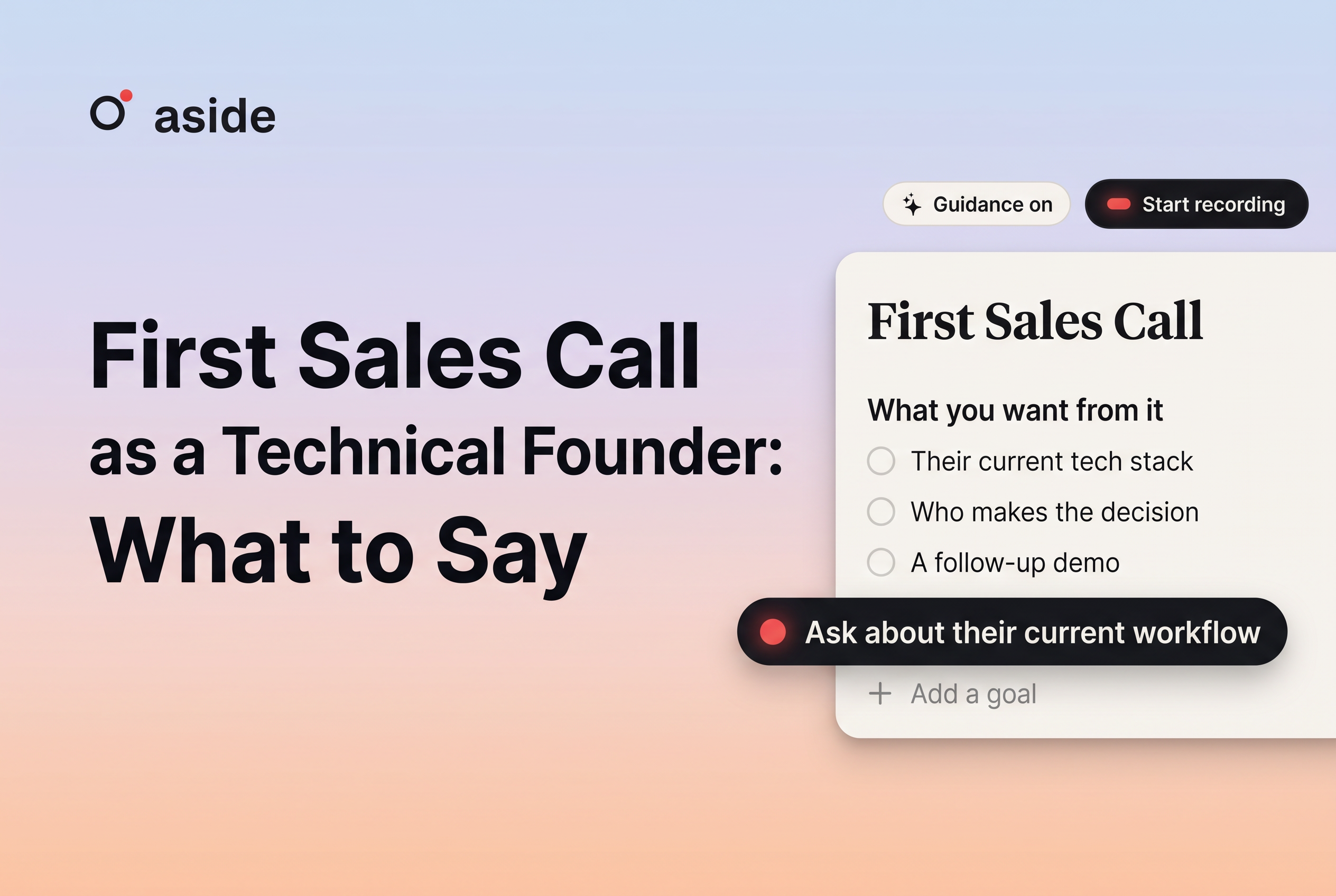
Aside is a Mac and Windows app that records calls on your computer and writes up notes, goals and next steps, with optional live guidance that shows your next move and your prepared answers on screen. No bot joins the call, and it works across Zoom, Google Meet, Teams, Slack huddles and FaceTime.
For a technical founder on a first call, three things help:
No bot in the room. Prospects don't see a notetaker join, so the call stays a conversation.
Live guidance for the hard moments. Prepare your answers to the security, integration and roadmap questions above in advance, and they're on your screen when the question lands.
A write-up afterwards. Summary, goals reached and next steps are written for you, and on Pro you also get a follow-up email, which saves the 20 minutes of CRM typing.
Privacy is simple: audio for English and 24 European languages is transcribed on your computer and not uploaded, text syncs to your account, and nothing is used to train AI models. Other languages, and computers too slow to keep up, are transcribed online.
Aside is free forever for unlimited recording, notes and transcripts, with live guidance and a write-up on 2 calls a week. New accounts get 14 days of Pro, no card. Pro is $48 a month, or $456 a year.
Whatever tool you use, capture the same five things after every first call: the problem in their words, what they've tried, the objections raised, who else is involved, and the agreed next step. After five or six calls the patterns tell you whether you have a real need or one prospect's feature request. For the next stage, Demo Call Script for Founders Selling Their Own Product is the natural follow-on.
FAQ: cold calling, a good sales call, and the rules of sales
Searchers ask a handful of related questions around this topic. Short answers below, with the longer versions in the FAQ section that follows.
Is tech sales a lot of cold calling? It depends on the role. Large enterprise software teams often split outbound prospecting from closing. Founder-led sales is different: early on you're more likely working warm intros, replies to your outreach, and inbound interest than dialling cold. Your first calls are usually with people who already said yes to a conversation, which is why diagnosis beats pitching.
What are the 7 golden rules, the 7 C's, or the rule of 6 in sales? These are popular frameworks with many versions, and no single canonical list exists. Most of them share the same thread as this post: understand the customer first, communicate clearly, be honest about what you can't do, and always secure a next step. If you want one rule to memorise, use this: diagnose before you demo.
Run your next first call as a diagnosis, then write it up in one click
The founders who sell well early aren't the ones with the best demo. They ask better questions, say "I don't know yet" without flinching, and leave every call with a dated next step. Do that on your next technical founder sales call, and put your prepared answers for security, integrations and roadmap where you can see them. Download Aside, take the 14 days of Pro with no card, and let it write up the notes, goals reached and next steps while you stay on the call.
Questions
How do you make a good sales call?
Open with a short agenda, ask how the buyer handles the problem today, listen for a recent real example, show only what matches it, and end with one concrete next step plus a short recap in their words. Afterwards, record the problem, objections and next step. Aside can write those up for you without a bot joining.
How to do technical sales?
Lead with the outcome the buyer cares about, not the architecture. Demo only the two or three features tied to their problem, and answer technical depth when asked, in a few plain sentences. Offer a separate session for technical evaluators. If you don't know something, say so and commit to a dated follow-up.
Is tech sales a lot of cold calling?
Not always. Larger sales teams often have dedicated prospectors, while founder-led sales in early-stage startups leans on warm intros, replies to outreach and inbound interest. Your first calls are usually with people who agreed to talk, so the skill that matters most is running a good diagnostic conversation, not dialling cold.
What should I do after a first sales call as a technical founder?
Within the hour, send a short recap using the buyer's own words and confirm the next step. Log the problem, what they've tried, objections and who else is involved. Aside records the call on your computer and writes the notes, goals reached and next steps, so the write-up is mostly done when you hang up.