A design partner call is a live conversation where you ask a target customer to use your unfinished product in real work, give structured feedback, and agree a named person, a cadence and an end date. You win it by learning their problem for 20 minutes, then making one explicit ask before you hang up.
Most founders get the first part right and fumble the second. They run a pleasant discovery chat, say "let's keep in touch," and never find out whether the person would have signed. The call ends warm and goes nowhere.
This is the script for the call itself: what to say, in what order, and how to answer the questions that make you freeze, like "is this a free trial?" and "what do I get?"
What a design partner call is (and what it isn't)
A design partner call is a negotiation for a working relationship. It is not a demo and not a sales pitch. A design partner is an early target customer who uses an unfinished product in real workflows and gives structured input so you can shape it. In return they get early access, influence over relevant product decisions, and usually direct support or favourable pricing (Design partner program guidance, 2026).
It is not a free trial. A trial says "try it if you feel like it." A design partnership says "we both commit time, and we both know how this ends." That difference is the whole call.
It is also not a promise to build whatever they ask for. Feedback can shape the roadmap. It does not obligate you to ship every request. Say that out loud early, because it is much easier to state it in minute 20 than to walk it back in month two.
If you are still on first calls with cold prospects, start with First Sales Call as a Technical Founder: What to Say. This post assumes the person on the line already has the problem and agreed to talk.
Before the call: pick the goals you must leave with
Walk in with four goals written down, and treat the call as failed if you miss two. Goals beat scripts because the conversation will go off-script and you need something to steer back to.
The four goals:
Confirm the pain is real and recent. You want a specific story from the last month, not "yeah that's annoying sometimes."
Identify the person who would actually use it. Not the person on the call if they are only the sponsor.
Make the explicit ask. Design partner, for a stated period, with stated commitments.
Leave with a named person, a cadence and an end date. Or a dated next call to settle them.
Also decide your walk-away line before you dial. If they will not name a user or commit 30 minutes every two weeks, they are interested, not a partner. Interested is fine. It just goes in a different column.
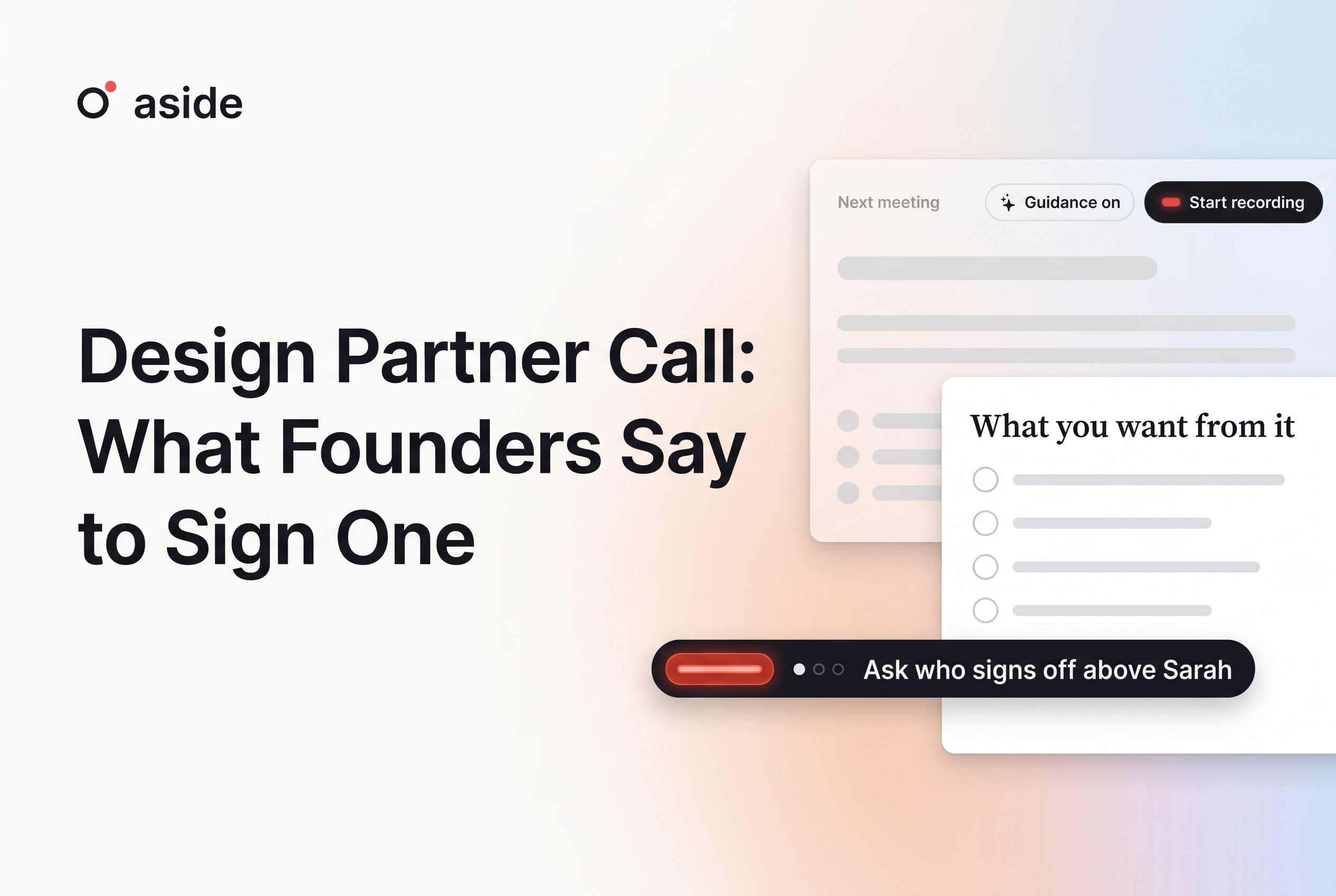
If you want these goals in front of you during the call, Aside is a Mac and Windows app that records calls on your computer, writes up notes, goals and next steps, and optionally shows your next move and prepared answers on screen with no bot joining. Put the four goals in your plan and it tracks which ones you reached.
The first 30 minutes: what to say, step by step
Spend the first 20 minutes on their problem and the last 10 on the ask. Founders reverse this and then wonder why the ask feels like a pitch.
Minutes 0 to 3: set the frame. Say it plainly: "Thanks for making time. We're building [product] for [type of team] dealing with [problem]. We're early, so I'd like to understand how you handle this today and see whether there's a fit to work together." The words "work together" plant the idea without asking for anything.
Minutes 3 to 15: ask about real behaviour. Use past-tense questions. "Walk me through the last time this happened." "What did you try?" "What did that cost you?" "Who else was involved?" Past behaviour tells you more than "would you use this?" ever will.
Minutes 15 to 20: reflect it back. "It sounds like [their specific issue] is costing you [impact], and the workaround is [thing]. Did I get that right?" If they correct you, good. You now have their words, and you will use them in the ask.
Minutes 20 to 25: pitch in two sentences. "That's the problem we're solving. We're building [solution], it's early, and we're looking for a small number of partners to shape it." Stop. Do not demo everything. A long pitch here turns a design partner conversation into a vendor evaluation.
Minutes 25 to 30: test readiness. "What would need to be true for this to be useful to your team?" Then listen for a user, a decision-maker and time. If you want the same discipline in a longer product walkthrough, Demo Call Script for Founders Selling Their Own Product covers it.
How to make the design partner ask without sounding desperate
Make the ask as a trade with terms, not a favour. Desperation comes from vagueness. "Would you maybe want to try it and tell us what you think?" sounds like begging. A specific offer sounds like a plan.
Here is the wording to use:
"I'd like to invite you to be a design partner for the next [8 weeks]. You get early access, setup help and direct access to me. In return, we ask for one named person who uses it, a 30-minute check-in every two weeks, and honest feedback on what works and what doesn't. We'll agree on what success looks like up front, and if it's working we'll talk about a paid plan at the end. Is that worth exploring?"
Three things make this land. It names what they give and what they get. It has a time box, which makes saying yes cheap. And it ends in a question they can answer in one sentence.
Then stop talking. The silence after the ask is where founders panic and add a discount, a free year or three extra features. Wait. If they need a moment, let them.
Keep the ask honest. Do not promise features or outcomes you cannot deliver. A partner who feels misled in week three is worse than no partner.
Answers for the questions you weren't ready for
Prepare one-breath answers to five questions, because these are where founders freeze.
"Is this just a free trial?" "No. A trial is you poking at it alone. This is a defined period where we both commit time: you give us a named user and regular feedback, we give you early access and our attention. We agree success criteria first."
"What do I get?" "Early access, direct support from me, real influence on the parts of the product that touch your workflow, and [pricing or discount you've decided] if it works out. I won't promise every request gets built, but your use case will shape priorities."
"What will this cost?" Decide before the call. Either "free during the partnership, then we discuss a paid plan if success criteria are met," or a stated discount. Do not improvise a number live. If price is the real objection, Price Objection on a Sales Call: What to Say and No Budget Objection: What Founders Say on a Sales Call cover the wording.
"What about security and our data?" Answer only what is true and documented. If you do not know, say so: "I don't want to guess. I'll send you a written answer by tomorrow." Then do it.
"We already use something for this." "That's useful to know. What does it do badly?" Their answer is your pitch. More on this in We're Happy With Our Current Provider: What to Say.
The worst answer to any of these is a confident guess. "I'll come back to you on that" is a fine thing for a founder to say, as long as you come back.
Close the call: named person, cadence, success criteria, end date
Do not hang up until you have four things said out loud: a person, a rhythm, a measure and a date. Verbal agreement in the last two minutes is what separates a design partner from a nice chat.
Use this close:
"Great. Let me make sure we agree. Who's the one person who'll use it day to day? [Name.] We'll meet every two weeks for 30 minutes. For the first period, success means [specific, measurable outcome, in their words from minute 15]. We'll run it for [8 weeks], ending on [date], and we'll review then whether it makes sense to continue on a paid plan. Does that match what you're thinking?"
Then book the first check-in on the call, while both calendars are open. A follow-up "sometime next week" has a way of becoming never.
A design partnership is a co-development agreement, so put the terms in a short written note afterwards: scope, cadence, access and data handling, fees or discount, confidentiality, how you use their feedback, and what happens at the end. Short means one page. Long agreements scare early partners and slow signature past the point of momentum.
After the call: write it up the same day
Send the written recap within a few hours. The details fade fast, and the recap doubles as the agreement draft. Include the named person, cadence, success criteria, end date, what each side provides, and the one thing you promised to follow up on.
A solid recap has five lines:
Problem as they described it, in their words.
What we agreed: partner, period, check-in rhythm.
Success criteria.
What each side provides.
Next step with a date.
Founders skip this when they are juggling five calls a day. Aside removes most of that work. It records the call on your computer and writes up the notes, goals reached and next steps, so you finish the call with the structure of your recap already drafted. Audio is transcribed on your computer for English and 24 European languages, nothing is used to train AI models, and no bot joins the call, so the person across the table sees nothing unusual. The free plan includes unlimited recording, notes and transcripts. Pro adds the follow-up email, summaries and write-ups on every call, and new accounts get 14 days of Pro with no card.
Send the recap, book the first check-in, and log the partner. Then run the next call the same way.
Run your next design partner call with the four goals in front of you
You do not sign design partners with charm. You sign them by learning the problem, making one explicit ask with terms, and refusing to leave without a name, a cadence, a success measure and an end date. Before your next call, write those four goals into an Aside plan, record the call, and let it draft the notes, goals reached and next steps while you write the recap. Download Aside at asidehq.app and use the 14 days of Pro on the call you already have booked.
Questions
What is a design partner call?
A design partner call is a live conversation where you ask a target customer to use your unfinished product in real work and give structured feedback. You learn their problem first, then make an explicit ask with a time period, a named user, a check-in cadence and success criteria. Aside can record the call and write up notes, goals reached and next steps.
How long should a design partner call be?
Plan for 30 minutes. Spend roughly 20 on their problem and how they handle it today, then about 10 on a short pitch, the explicit ask and the close. Book the first check-in before you hang up. Aside records the call on your computer and writes the notes afterwards, so you can stay in the conversation.
What should a design partner get in return?
Early access, direct founder support, real influence on the parts of the product that touch their workflow, and usually free or discounted pricing during the partnership. Be clear that feedback shapes priorities but does not guarantee every request gets built. Put the terms in a short written recap, which Aside's notes and next steps help you draft.
Is a design partner the same as a free trial?
No. A free trial is self-directed and has no commitment from the user. A design partnership is time-boxed co-development: they name a user, attend regular check-ins and give feedback, and you provide early access and attention against agreed success criteria. State this on the call so expectations match.
What should I do right after a design partner call?
Send a written recap the same day with the problem in their words, the named person, cadence, success criteria, end date and your follow-up. Aside records the call on-device and writes notes, goals reached and next steps, and Pro includes a follow-up email, which makes the recap quick to send.