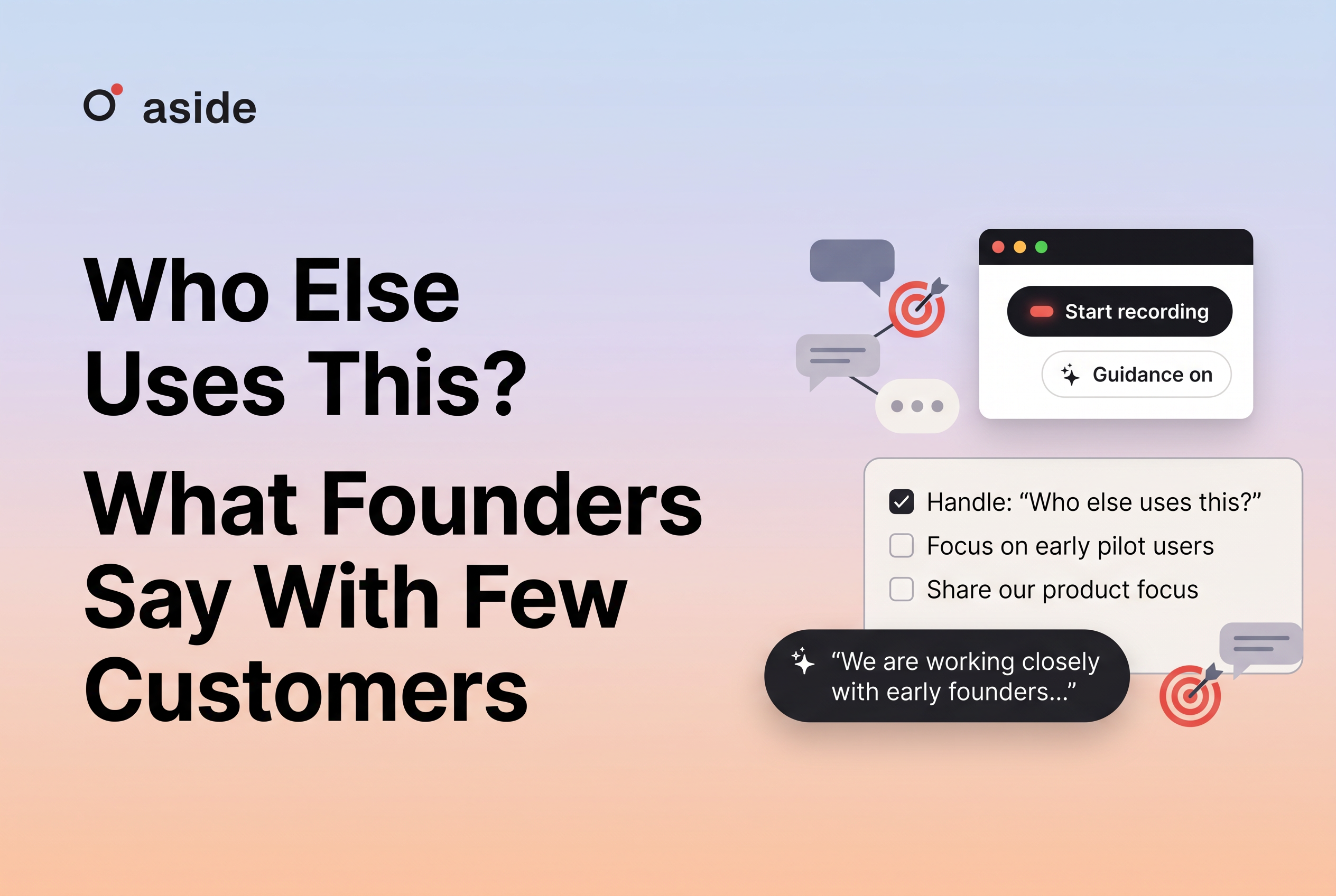
When a prospect asks "who else uses this?", the honest reply is that you're early, you'll say exactly where you are, and you'll offer a low-risk way for them to test the product. The question is rarely about logos. It's a risk question: if I pick you and you disappear, or the product disappoints, how exposed am I? Answer that, and the objection mostly goes away.
The "who else uses this" objection hits early-stage founders hardest because the true answer is short. This post gives you scripts for zero customers, one customer and a handful, a way to tell what the prospect is really asking, and a list of replies that will cost you the deal later. Then it covers how to keep the right answer in front of you when you're live on a call and your mind goes blank.
What "Who Else Uses This?" Really Asks (and an Example of the Objection)
It asks whether choosing you is safe. The buyer is not collecting logos for a slide deck. They are trying to work out who gets blamed if this goes wrong, and whether anyone has already absorbed that risk before them.
Here is what the objection sounds like on a real discovery call:
"This looks useful. Who else is using it? Anyone in our space?"
The words are about other customers. The concern underneath is one of three things: will this still exist in a year, will it actually work for a team like mine, and will I look foolish for backing it. Each one has a different honest answer.
So don't treat this as a proof gap you have to paper over. Treat it as a risk question you can answer directly. That changes your whole reply. You stop defending a thin customer list and start shrinking the buyer's exposure, which a founder can do better than a big vendor can.
What to Reply When You Have No Customers Yet
Say you're early, say it first, and move straight to how you'll make testing safe. Never imply customers you don't have.
A script that works:
"Honest answer: we're early, so there's no one in production yet. You'd be among our first. That cuts both ways. You get my direct attention on onboarding and a real say in what we build. What would you need to see to feel comfortable testing it?"
Three things happen in that reply. You admit the fact in one sentence, so there's nothing for the buyer to uncover later. You turn the gap into something concrete you can deliver, which is access and influence. And you end on a question, which hands the buyer the job of naming their own risk.
Then offer a safeguard. Pick the ones you can actually keep:
A small, time-boxed trial with success criteria agreed up front
An easy exit, with no long commitment
A walkthrough of the exact workflow on your own screen, so they judge the product and not the logo wall
If you have no customer proof, you can still show your own background. One line on why you built this and what you did before is real evidence about the person they're betting on. Keep it factual and short.
The founder-led advantage is real, but present it as a commitment, not as a substitute for customer evidence. "I'll be on your onboarding call" is a promise. "You'll love working with a startup" is a hope.
What to Say When You Have a Few Early Users
With one to a few real users, describe them truthfully by type and use case. Offer a specific, verifiable detail instead of a name you can't use yet.
If you have a single design partner:
"We have one team using it right now, a [type of team] using it for [use case]. It's early, and I won't pretend otherwise. I can tell you what they use it for and what we changed after their first two weeks. If it helps, I can ask whether they'd be open to a short reference chat."
If you have a handful:
"We have a few early users, mostly [type of user]. None are big names yet. What I can show you is how they use it for [use case], and what we'd measure in a trial for you."
Two rules keep this honest. First, say "early users," not "customers," if nobody is paying or the use is a trial. Second, ask permission before you offer anyone as a reference, and only offer what is true today.
As those users come in, ask each one for permission to share a specific outcome, not just a logo. A sentence like "cut our setup from two days to one afternoon" does more work than a name on a slide, and it's checkable. Build the short case study from that. Until you have it, don't gesture at results you can't back.
Which Type of Objection Is It? Risk, Proof, or Stalling
Listen for which of three things the buyer means, because each needs a different reply. It's the same sorting you'd do for any objection: figure out the type before you answer.
Risk. "Who else uses this?" means "is it safe to go first?" Reply with safeguards: a small pilot, clear success criteria, an easy exit. This is the most common case with early-stage products.
Proof. The buyer wants evidence it works for their situation. Reply with a demo of the exact workflow, a similar problem you've solved, or a user of the same type if you truly have one. Show the product do the job.
Stalling. The question is a polite way to end the call. Test it: "If I could point to a team like yours using it, would you move ahead, or is something else holding it back?" If the answer is vague, the objection is not the real one. The same logic applies to other soft objections. The no budget objection and the happy with our current provider objection often hide the same unspoken worry.
One quick check works for all three: answer honestly, then ask "what would you need to see?" Their reply tells you which type you're facing.
What Never to Say: Invented Logos and Vague Pilots
Never invent a customer, and never describe a pilot as live when it isn't. Both fail the moment the buyer asks one follow-up.
Replies to cut from your repertoire:
"We work with teams like yours." Which ones? If you can't name a single true example by type, this implies a customer you don't have.
"We're in pilots with a few companies." If those pilots are conversations and not usage, this is false. Buyers ask who and what stage. You'll either lie again or fold.
"I can't share names, it's confidential." Fine if true. If it's a cover for having none, it reads as exactly that.
"Everyone in the space is talking to us." Interest is not usage, and the buyer knows the difference.
There's a practical reason beyond ethics. A prospect who later finds a gap between what you said and what was true stops trusting everything else you told them, including the parts that were accurate. A founder who says "we're early" on the first call sounds credible on every other claim. The honest answer is also the one you can repeat identically on call two without remembering what you said.
Prepare Your Answer Before the Call, Then Keep It in Front of You
Write your answer before the call, in three versions (none, one, a few), so you aren't improvising the hardest sentence of the conversation. Then make sure it's on screen when the question lands.
The moment someone asks "who else uses this?" is exactly when founders freeze, over-explain, or reach for a vague claim to fill the silence. A prepared answer you can't recall is no help.
Aside is a Mac and Windows app that records calls on your computer, writes up notes, goals and next steps, and optionally gives live guidance without a bot joining. You can say it in your own words instead of scrambling.
Because no bot joins the call, the buyer sees a normal conversation. Aside runs on Zoom, Google Meet, Teams, Slack huddles and FaceTime. It works on Apple silicon Macs (macOS 14.2 or later) and on Windows 10 (version 2004 or later) or Windows 11 on x64. Free forever gives you unlimited recording, notes and transcripts, plus live guidance and a write-up on 2 calls a week. New accounts get 14 days of Pro with no card.
Pair this with a clean demo structure. The demo call script for founders selling their own product shows where this objection tends to appear, and first sales call as a technical founder covers the wider case of selling before you have proof.
After the Call: Record the Objection and the Agreed Next Step
Write down the exact objection and the next step the buyer agreed to, or you'll lose both within a day. "Who else uses this?" is data. How often it comes up, and what resolved it, tells you what proof to build next.
Capture three things after every call where it appears: the buyer's exact words, which type it turned out to be (risk, proof or stalling), and the commitment you left with, such as a trial start date or a reference chat to arrange.
Aside records the call on your computer and writes up notes, goals reached and next steps, so you don't rebuild this from memory. Audio is transcribed on-device for English and 24 European languages, nothing is used to train AI models, and the text syncs to your account. Pro adds summaries and a follow-up email, which is handy when the agreed next step is a small pilot you want confirmed in writing the same day.
After ten calls, read the notes together. If six buyers asked for the same kind of proof, that's your next case study. If most turned out to be stalling, your qualification needs work, not your reference list.
Write Your Honest Answer Once, Then Keep It Ready
The best reply to "who else uses this?" with few customers is the true one, delivered calmly, followed by a low-risk way to test. Founders lose these deals by bluffing, not by being early. Write your three versions today (none, one, a few), keep them ready, and run your next discovery call with the reply prepared instead of scrambling in your head. Start on the free plan and use the 14 days of Pro on your next real call.
Questions
What do you say when a prospect asks who else uses your product and you have no customers?
Say you're early and that you'd be among the first users, then explain what that gives them: direct founder attention and real influence on the product. Ask what they'd need to see to feel comfortable, and offer a small time-boxed trial.
What is an example of the "who else uses this?" objection?
A prospect says, "This looks useful. Who else is using it? Anyone in our space?" The words ask about other customers, but the real concern is risk: will it work, will you still exist, and who gets blamed if it fails. Answer the risk honestly rather than listing logos you don't have.
What are the three types of objections?
For this objection, treat it as risk, proof or stalling. Risk means they fear going first, so offer safeguards like a pilot and an easy exit. Proof means they want evidence it works for them, so demo the workflow. Stalling means it's a polite exit, so test it by asking what else is holding them back.
Can I say I'm in pilots if conversations are still ongoing?
No. Describe pilots only if people are actually using the product. Buyers ask who and at what stage, and a vague claim collapses on the first follow-up. Say "early users" when that's true, or "we're early" when it isn't, and offer a concrete trial instead.
How can I keep my answer ready during a live call?
Write your honest reply before the call and store it where you can see it. Aside's optional live guidance helps you know what to say next, and no bot joins the call. It runs on Mac and Windows, and the free plan includes live guidance on 2 calls a week.